One Plot. Two Families. 25,000 Sq.Ft. of Shared Luxury.
The Story of How We Designed the Twin Bungalow at Science City, Ahmedabad
By Harikrushna Pattani | Principal Architect & Founder, Harikrushna Pattani & Associates | Ahmedabad | 11th May 2026
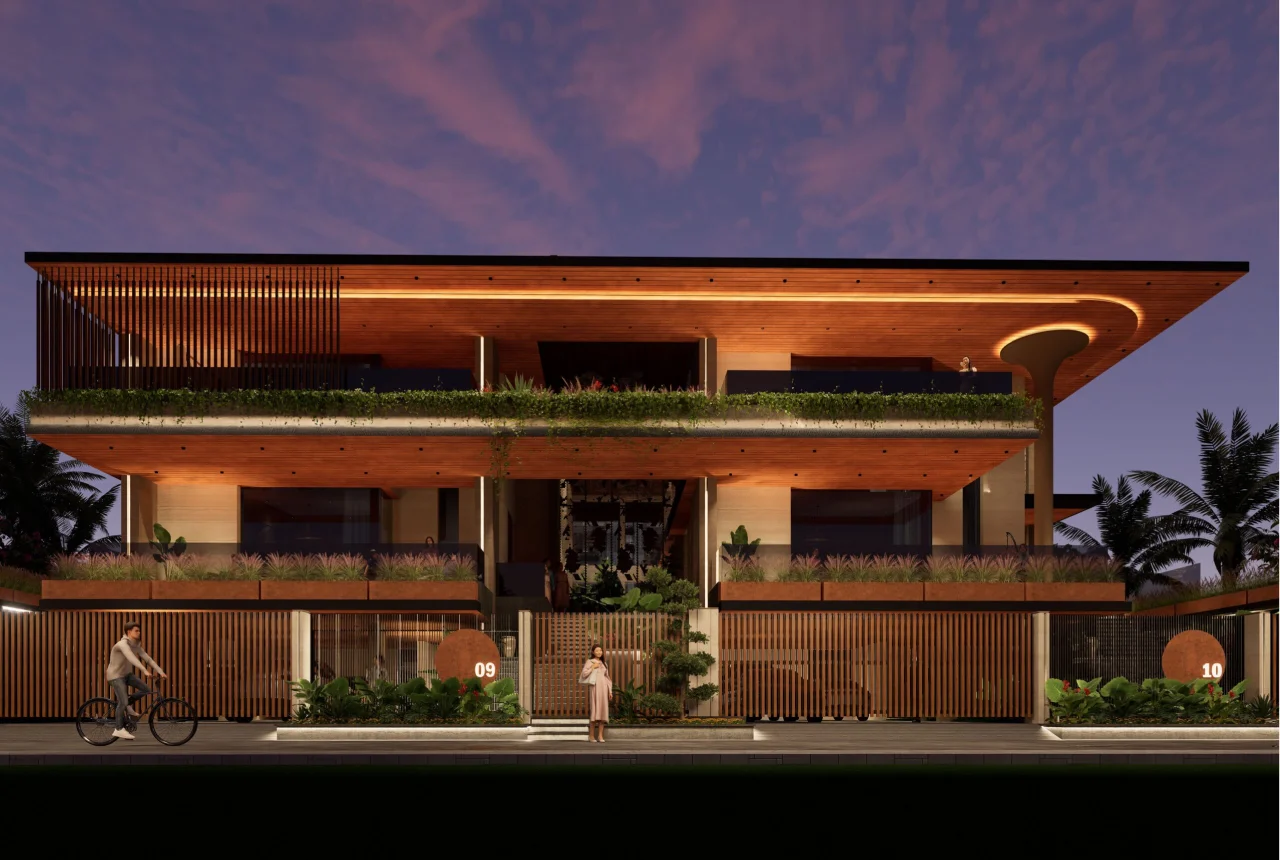
Two families.
One home.
Not two houses with a shared wall. Not a numbered gate for each.
One plot. One address. One 25,000 sq.ft. world on Science City Road, Ahmedabad. Two brothers and their families live together, separately, and well.
This is the story of the Twin Bungalow at Science City.
It is the most complex residential project we have done. Not because of the size, though 25,000 sq.ft. across two wings is a serious undertaking. But because the real problem we had to solve wasn’t architectural.
It was about how a family wanted to live. The architecture came after.
The Brief That Changed How We Think About Family Homes
The first meeting was a simple one. Two brothers, same street they’d grown up on, same instinct to keep the family close as their own children came along.
But they’d also learned what most families learn: that closeness has a breaking point if there’s no room to step away from it.
“We want to be close. But we need our own space. We don’t want our children growing up in separate houses across the city, but we also can’t live on top of each other.”
That was the brief. Simple in words. Difficult in architecture.
Joint family homes in Ahmedabad are nothing new. Gujarati families have shared plots for generations. What was different here was the expectation. These two families didn’t want a split plot or a subdivided house. They wanted their own complete home, private and finished, that happened to sit next to their brother’s.
They weren’t asking us to divide a house.
They were asking us to design a home for a relationship.
The Architecture Question: One Home or Two?
The easy option was two mirror-image structures on the same plot. One gate each. Clean separation. It’s how most twin bungalows get built. It’s also exactly wrong for what this family needed. Two separate houses would have defeated the point of sharing a plot.
We designed one structure. One home from the outside. Two complete, private homes from within.
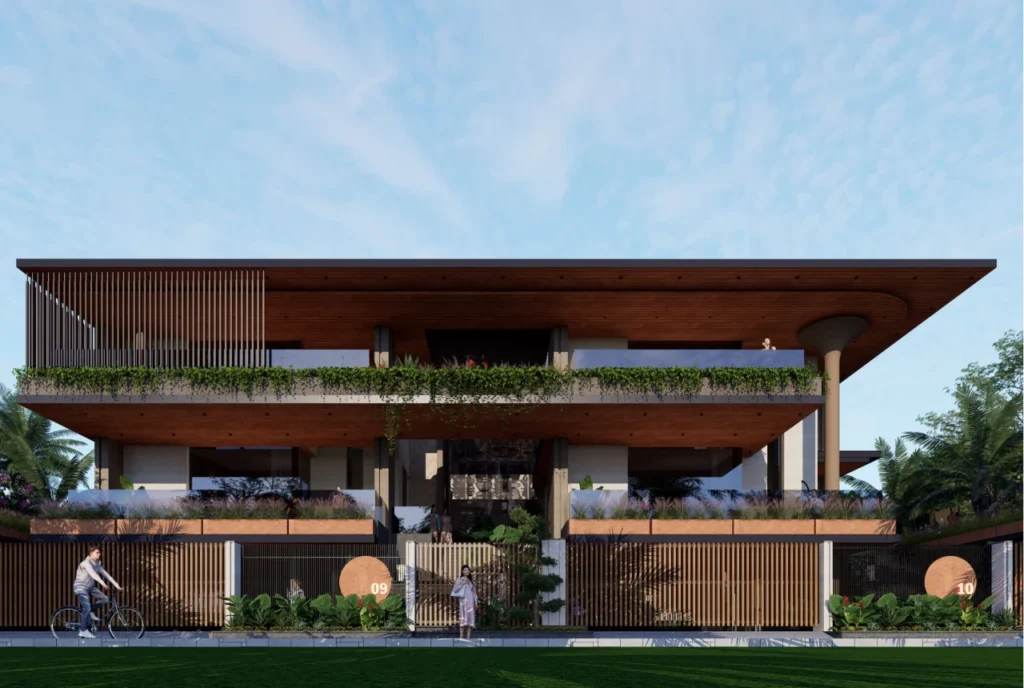
“A home on Science City Road should have presence. One unified facade gives this bungalow that. Two separate designs would have given it half.”
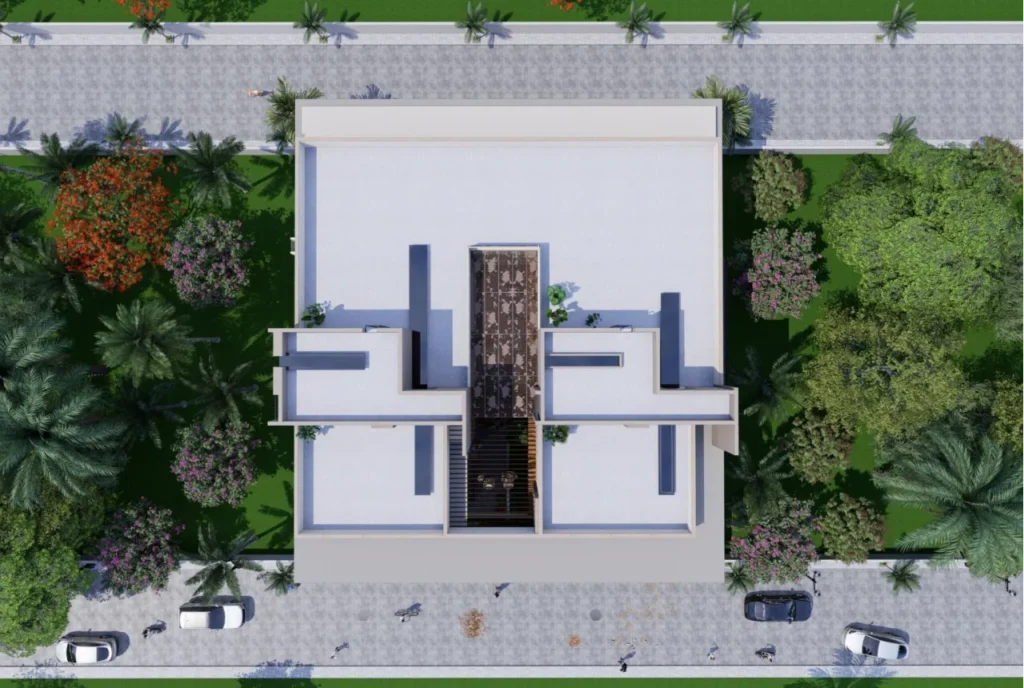
From the road: one gate, one driveway, one roofline that runs the full width of the plot. Cross the entrance threshold and the home starts to divide, quietly. A half-level change. A teak screen. A courtyard that opens up at the centre and belongs to both families equally.
Vastu and Orientation
Both families had Vastu requirements. The plot faces east, which meant we could orient the primary bedrooms east and the prayer rooms north, for both wings and without compromise. The central courtyard became the Vastu heart of the home: open sky, north light, the right relationship to the street.
We worked with the family’s Vastu consultant from the first sketch. Not as a check at the end. As a design voice from the start.
Designing Privacy Without Walls: The Shared Spaces
Privacy isn't about walls. It's about design.
The entrance foyer, central courtyard, arrival portico and guest parking were designed to feel like they belong to both families. Not like corridors between private spaces. Like rooms both families want to be in.
The arrival portico is wide and covered. Coming home feels unhurried here.
“The garden is where both families meet, by choice, not by accident. That is the difference between a plan that forces togetherness and one that invites it.”
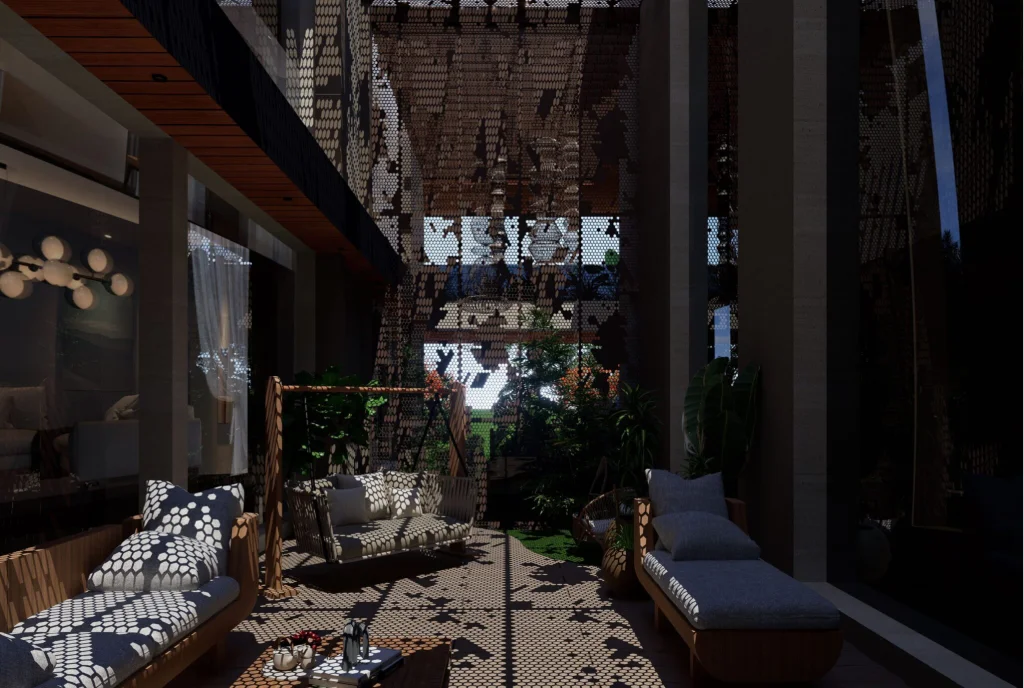
The central courtyard is open to the sky. Large canopy trees shade it through Ahmedabad’s summer. A covered walkway connects both wings at ground level. You can get from one side to the other without going through anyone’s front door.
Kota stone on the courtyard floor. Teak vertical screens at the boundary, the same teak you see on the facade outside, so the building reads as one thing from every angle. A water feature you hear from the driveway before you see it once you’re inside.
None of that is decoration. It is the difference between a house that functions and a home that feels right.
The Private Wings: Where Each Family Is Completely Alone
Each wing was designed around how that family actually lives. Not around a standard floor plan.
Wing A and Wing B share a family name. Almost nothing else.
Wing A: Contemporary and Calm
The elder brother wanted clean lines and natural light. The living room is double-height, with a mezzanine reading corner that looks down over the central courtyard. Three sides of glazing catch the morning. It is a room that never feels dark.
The master suite takes the whole east wing on the first floor. Private terrace, walk-in wardrobe, ensuite with a freestanding bath. It sits above the garden and faces the morning sun. Nobody else in the house sees that view.
“The terrace off the master bedroom in Wing A is the most private space in the whole house. Only one family ever stands on it. That kind of privacy is what luxury actually means.”
The kitchen has an island, integrated appliances, and a breakfast nook that catches the sun through the east window. It opens into the dining room through a wide arch rather than a door, so the cook is part of the meal, not behind a wall.
Wing B: Warm, Textured, Layered
The younger brother’s family wanted something warmer. Darker wood tones throughout. Handmade tiles in the kitchen. Custom joinery built to spec.
Their living room opens to a private garden that belongs only to them. A jasmine hedge along the edge. The smell comes in through the windows on summer evenings. The children have a dedicated play corridor between their rooms. The parents asked for it specifically. They’d grown up in a house where the in-between spaces were where childhood actually happened. They wanted that for their kids too.
That detail wasn’t in any brief document. It came up in conversation. Those are the details that matter.
Materials, Light, and the Climate of Ahmedabad
Ahmedabad’s climate asks a lot of a building. Summers above 42 degrees. A hard monsoon. Cold mornings in January. A home on Science City Road has to work through all of it, not just look good in photographs.
Passive Cooling
Both wings face east and north, avoiding the worst of the afternoon western sun. The overhangs on the south and west are deep enough to shade the glazing without blocking daylight. The central courtyard draws hot air upward and out, pulling cooler air in from the covered walkways at ground level.
This reduces the load on air-conditioning. In a house this size, that is a material difference in running costs, and in how the air inside the house feels.
Materials
The exterior is Dhrangadhra stone and textured cement plaster. Dhrangadhra stone is quarried 150 km from Ahmedabad, warm grey, and it gets better-looking with age. The plaster reads differently depending on the hour: sharp in morning light, soft at dusk.
Makrana marble in the formal rooms. Natural teak in the bedrooms. Both materials need almost nothing from you and give a great deal back over time.
“We chose things that would look better in ten years. That is how you build a house a family never wants to sell.”
Landscape
The outdoor area on a 25,000 sq.ft. Science City plot is not small. We worked with a landscape architect on it from the beginning. Neem trees along the perimeter for shade and privacy. Indian Champak in the courtyard, chosen as much for fragrance as for the canopy. Bougainvillea along the driveway edges, which asks for almost no water once it takes hold.
The landscape does real work here. It cools the approach. It muffles the road. It makes the place feel like it has always been there.
5 Things This Project Taught Us About Designing for Joint Families in Ahmedabad
Every project teaches you something. Here is what this one taught us.
1. Agree on what 'shared' means before you draw anything.
The floor plan follows the family’s values. If both families agree on what ‘together’ and ‘private’ look like before the first sketch, the design writes itself. If they don’t, no plan fixes it.
2. Privacy is a design tool, not a structural one.
A level change. A screen. A different ceiling height. A hedge. These create privacy that feels accidental and real. Walls create privacy that feels like an argument.
3. One facade beats two every time.
On a road like Science City Road, a home that reads as one landmark has more presence than two smaller structures. Both owners benefit from that presence. Splitting the facade gives both families less.
4. Have the shared budget conversation early. Put it in writing.
Both families pay for the shared structure, the driveway, the courtyard, the services. If that conversation happens late, it causes problems that no design can solve. We make it part of the briefing process, before any drawings start.
5. Build around the family, not the plot.
The best joint family homes we’ve worked on ask two questions first: where will both families want to be together? Where will each family want to disappear? Answer those and the layout follows naturally. Maximise square footage first and you end up with something technically correct that nobody loves.
If You're Planning a Joint Family Home in Ahmedabad
The Twin Bungalow at Science City is the most considered home we’ve designed. Not because of the scale. Not because of the Dhrangadhra stone or the Makrana marble.
Because it solved a family problem first. Then we designed the house.
If you’re planning a joint family home, a twin bungalow, or a large bungalow on Science City Road, call us. We’ve done this before.
We don’t start with floor plans. We start by understanding the way you want to live.
That conversation is free. The floor plan comes after.
Frequently Asked Questions
What is a twin bungalow in Ahmedabad?
A twin bungalow is a single building on one plot that houses two separate families, usually brothers or parents and adult children. Each family gets their own complete private home. Selected spaces like a courtyard or entrance are shared. Unlike a duplex, a good twin bungalow looks like one house from the street.
How do you design a bungalow for a joint family in Ahmedabad?
Start by agreeing on what each family shares and what they own privately, before any drawings. Use level changes, visual screens, and landscaping to create genuine privacy rather than just walls. Sort out Vastu orientation for both wings early. Agree on the shared cost split in writing. HPA runs a joint family briefing session before any design work starts.
How much does a twin bungalow design cost in Ahmedabad?
A twin bungalow of 20,000 to 30,000 sq.ft. in Ahmedabad typically costs between Rs 1,400 and Rs 2,200 per sq.ft. for construction, depending on the quality of finishes. Architect fees run 6 to 10 percent of construction cost. The actual number depends on the plot, the specification and the complexity of the design. HPA provides a detailed cost breakdown in the initial consultation.