BOQ vs Estimate vs Quotation: What Homeowners Must Understand Before Construction
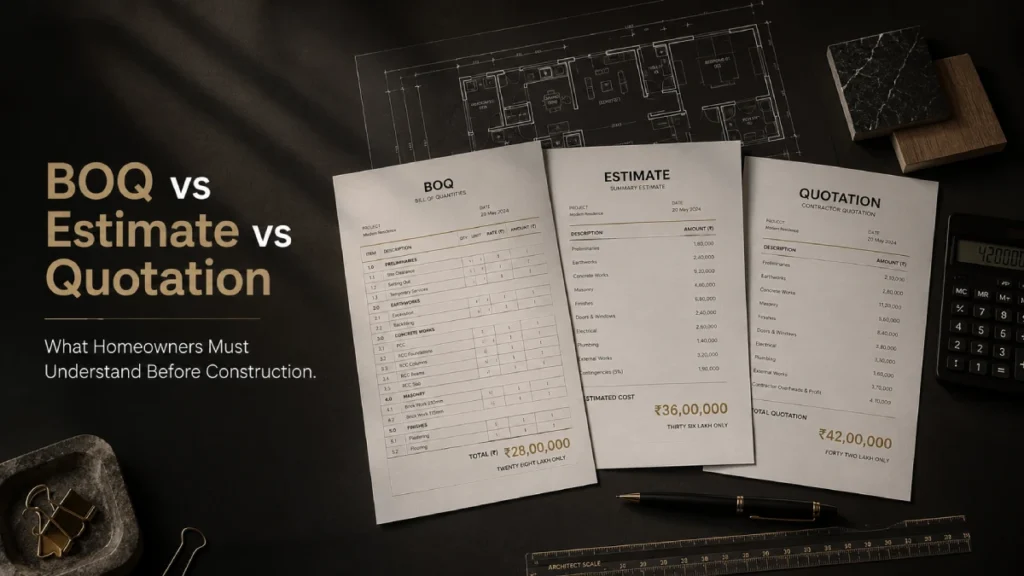
You call three contractors for your 4BHK interior project in Ahmedabad. One says ₹28 lakh. Another says ₹36 lakh. The third says ₹42 lakh. Now you are stuck.
Is the ₹42 lakh contractor overcharging? Is the ₹28 lakh contractor giving a good deal? Or is something important missing from the cheaper quote?
This is where many homeowners, business owners and even NRI clients get confused. They receive different pricing documents such as an estimate, a BOQ and a quotation, but they are not always told what each one actually means.
The problem is not the price difference alone. The real problem is that each contractor may be pricing a different scope.
One may include premium hardware. Another may include only basic laminate. One may include waterproofing. Another may leave it as an extra item. One may include electrical points clearly. Another may just write “electrical work included” without detail.
Before you approve any contractor, you need to understand three documents clearly: estimate, BOQ and quotation.
What Is an Estimate in Construction?
An estimate is an approximate budget idea. It is usually prepared at the early stage of a project, before every drawing, material and detail is final.
“Think of an estimate as a direction, not a promise.”
If you are planning a bungalow, an architect may look at the built-up area, number of floors, design complexity, expected finish level, structure, façade, interiors and services, then give you an approximate cost range. This helps you understand whether the project is financially comfortable before you go deeper into design.
For example, if a homeowner in South Bopal wants a premium bungalow with a double-height living room, landscaped garden, detailed façade, home automation and high-end interiors, the early estimate will naturally be different from a simple compact home with basic finishes.
At this stage, the estimate helps you answer one important question: “Is this project direction realistic for my budget?” It does not answer: “What will the final contractor cost be?” That comes later.
When Is an Estimate Useful?
An estimate is useful during early decision-making. It helps you decide whether to move ahead with a project, adjust the scope or change the quality level.
For a business owner planning a clinic interior, an estimate can help decide whether the project should be a basic functional setup, a mid-range interior or a premium patient-experience-led space.
For a homeowner planning a renovation, an estimate can help decide whether to renovate room by room or do a complete transformation at once.
For an NRI client planning a home in Ahmedabad, an estimate helps set an early financial expectation before detailed drawings and vendor discussions begin.
What an Estimate Should Not Be Used For
An estimate should never become your final contractor budget. This is one of the biggest mistakes clients make.
A client hears “around ₹35 lakh” and assumes the project will finish at that number. Later, they realise that loose furniture, lighting fixtures, premium hardware, waterproofing, taxes if applicable, appliances, outdoor work or site changes were not included.
This does not always mean anyone misled the client. It usually means the client treated an early estimate like a final quotation.
“An estimate is a budget direction, not a budget promise.”
What Is a BOQ in Construction?
BOQ stands for Bill of Quantities. It is a detailed document that breaks the project into item-by-item work. A BOQ lists what needs to be done, how much quantity is involved, what unit is being measured, and often what material or specification is expected.
This is the most important document when you want to compare contractor prices properly.
“A BOQ converts drawings into prices. Without a BOQ, contractors are guessing. With a BOQ, everyone is quoting the same scope.”
What Does a BOQ Usually Include?
A BOQ may include items such as:
- Brickwork
- Plaster
- Flooring
- Painting
- Waterproofing
- False ceiling
- Electrical points
- Plumbing fixtures
- Modular furniture
- Wardrobes
- Kitchen work
- Stone or tile cladding
- Doors and windows
- Hardware
- Labour work
- Finishing items
Each item is usually written with a quantity and unit. For example, flooring may be measured in square feet or square metres. Electrical points may be counted by number. Wardrobes may be calculated in square feet or running feet, depending on the scope. This makes the project easier to understand and easier to price.
Why BOQ Matters Before Contractor Quotation
A BOQ reduces guesswork. It also protects both the client and the contractor. For the client, it brings clarity. For the contractor, it defines what exactly needs to be priced.
Let’s say three contractors are quoting for wardrobes. One contractor may include basic laminate and regular hinges. Another may include premium laminate, soft-close hinges and internal accessories. A third may include only external shutters and exclude internal drawers.
If you only look at the final number, you may think one contractor is cheaper. But in reality, they may not be quoting the same thing.
“A BOQ helps you compare apples to apples.”
What a Good BOQ Should Include
A useful BOQ should generally include:
- Item number
- Work description
- Quantity
- Unit of measurement
- Material specification
- Rate column
- Amount column
- Remarks or exclusions where needed
- Reference to drawings where possible
For example, instead of writing “kitchen work,” a proper BOQ should break it down into:
- Base cabinets
- Wall cabinets
- Tall storage unit
- Countertop
- Sink provision
- Hob and chimney provision
- Hardware
- Shutter finish
- Backsplash
- Lighting
- Electrical points
- Plumbing points
This level of detail may look long, but it is extremely useful. It prevents confusion during execution.
A clear BOQ makes the difference. Book a consultation with HPA to understand how detailed scope planning prevents construction surprises.
What Is a Quotation?
A quotation is the contractor’s price offer for the work. It may be based on drawings, BOQ, site visit, material specifications and project timeline. A good quotation should clearly explain what the contractor is offering, what is included, what is excluded and how the payment will work.
“A quotation is only as good as the BOQ and drawings it is based on. If the drawings are incomplete and the BOQ is unclear, the quotation will also be unclear.”
What Should a Good Quotation Include?
A professional quotation should mention:
- Project name and location
- Contractor or vendor details
- Scope of work
- Item-wise rates or clear breakup
- Material brands or specifications
- Labour inclusions
- Transport or loading details where applicable
- Taxes if applicable
- Timeline
- Payment terms
- Warranty or defect responsibility where applicable
- Exclusions
- Validity period
- Conditions for extra work or variations
For example, if you are planning an office interior in Ahmedabad, the quotation should not simply say “office interior work.” It should clarify civil work, partitions, flooring, ceiling, furniture, electrical work, data points, lighting, paint, glass partitions, HVAC coordination and finishing details.
Why the Cheapest Quotation Is Not Always the Best
The cheapest quotation is tempting. But it may not always be the most complete or reliable option.
A lower quote may exclude waterproofing, premium hardware, site protection, debris removal, electrical conduits, finishing details or branded materials. These may later appear as extra charges.
For example, one contractor may quote lower for a bungalow renovation because waterproofing is not included. At first, the quote looks attractive. But when terrace leakage or bathroom seepage work becomes necessary, the client has to pay extra.
The problem is not that the contractor was cheap. The problem is that the scope was not clear.
BOQ vs Estimate vs Quotation: Simple Comparison
| Document | Meaning | When It Is Used | Usually Prepared By | Main Purpose |
|---|---|---|---|---|
| Estimate | Approximate cost idea | Early planning stage | Architect, consultant or contractor | Budget direction |
| BOQ | Item-wise quantity and scope breakdown | Before contractor quotation | Architect, quantity surveyor or consultant | Scope clarity and comparison |
| Quotation | Contractor's price offer | Before contractor finalisation | Contractor or vendor | Final pricing offer |
Notice the progression. An estimate helps you decide if the project is feasible. A BOQ helps you define what the project includes. A quotation helps you choose who will build it.
These are not competing documents. They are sequential documents.
The Correct Sequence Before Construction Starts
Estimate
The estimate comes first. It helps you understand whether the project direction suits your budget. At this stage, you may still be deciding the size, design language, material level and overall scope. The estimate is flexible because the project is still developing.
Drawings
Once the broad budget direction is clear, drawings define what is actually being built. Floor plans, elevations, sections, electrical layouts, plumbing layouts, furniture drawings, ceiling plans and interior details all affect the final cost. This is why detailed architectural drawings matter. They are the foundation of an accurate BOQ.
BOQ
After drawings and specifications are clearer, the BOQ breaks the project into measurable work items. This helps the contractor understand the scope properly before pricing. It also helps the client see where money is going.
Quotation
Now contractors can quote based on the same BOQ and drawing set. This is where comparison becomes meaningful. If one contractor is higher or lower, you can check the reason item by item. Maybe the material is different. Maybe the labour rate is different. Maybe something is excluded. Without a BOQ, you would never know.
Contract or Work Order
Once the contractor is finalised, the agreed scope, amount, payment terms, timeline, exclusions and variation process should be written clearly. Avoid verbal promises. If the scope changes after work begins, it should be documented and approved.
This sequence prevents the most common contractor surprise: “I did not know that was included.”
Common Mistakes Clients Make While Comparing Quotations
Mistake 1: Comparing Only the Final Total
One contractor says ₹28 lakh. Another says ₹36 lakh. Another says ₹42 lakh. The client naturally looks at the total. But the total alone does not tell the full story. One quote may include premium plywood, branded hardware and better finishing. Another may include basic material and exclude accessories. Until you compare the scope line by line, the final number does not mean much.
Mistake 2: Not Checking Material Specifications
"Premium quality" is not a specification. A proper quotation should mention material type, brand, thickness, finish and grade where relevant. This matters for plywood, laminate, veneer, tiles, stone, paint, wires, sanitaryware, lighting, hardware and glass. Both may say "laminate finish," but one may include basic laminate while another includes better-grade laminate with soft-close hardware.
Mistake 3: Ignoring the Exclusions List
Many disputes happen because clients do not check what is excluded. Common exclusions may include demolition, debris removal, waterproofing, light fixtures, appliances, loose furniture, taxes if applicable, transport, site protection, civil repair, extra electrical points and outdoor work. Before approving a quote, always ask: "What is not included?"
Mistake 4: Taking Quotations Before Drawings Are Final
If the design keeps changing, the quotation cannot remain accurate. For example, if the kitchen layout changes after the quotation, the cabinet size, countertop length, electrical points, plumbing points and backsplash quantity may all change. The better approach is to finalise the drawings first, then ask for quotations.
Mistake 5: Not Understanding Variation Costs
Changes after work starts usually cost extra. This is normal in construction, but it should be handled clearly. The issue is not variation. The issue is undocumented variation. Variation rates and extra work approval should be discussed before construction starts.
How BOQ Helps Different Types of Clients
For Homeowners
For homeowners, a BOQ brings peace of mind. A bungalow project can include structure, plaster, flooring, façade, waterproofing, electrical work, plumbing, landscape, interiors and finishing. With a BOQ, you can see the cost section by section. This helps you decide where to spend, where to control cost and where not to compromise.
For example, you may choose to reduce decorative wall panelling but keep waterproofing and electrical quality intact. That is a smarter decision than simply asking the contractor to “reduce the total.”
For NRI Clients
For NRI clients building or renovating in Ahmedabad, a BOQ is even more useful. When you cannot visit the site every week, you need documentation that keeps things clear. A BOQ helps you understand what work is planned, what work is quoted, what work is completed, what work is being billed, and what changes have been added. It reduces dependency on verbal updates and makes remote decision-making easier.
For Commercial Clients
Commercial projects have different risks. An office, clinic, showroom or hospital interior needs coordination between partitions, furniture, flooring, ceiling, lighting, HVAC, electrical points, branding elements and service areas. A vague quotation can create serious execution gaps. A BOQ helps commercial clients control cost and vendor scope more confidently.
Questions to Ask Before Approving a Contractor Quotation
Before you say yes to a contractor, ask these 10 questions:
- Is this quotation based on final drawings?
- Is there a BOQ attached?
- Are quantities clearly mentioned?
- Are material brands and specifications written?
- What is included in this quote?
- What is excluded from this quote?
- Are taxes included or extra, if applicable?
- What is the project timeline?
- What are the payment stages?
- What happens if the design or quantity changes later?
Also ask about warranty or defect responsibility where relevant. These questions may feel simple, but they reveal whether the quotation is truly clear.
How HPA Helps Clients Understand Scope and Pricing
At Harikrushna Pattani & Associates, the goal is to help clients move from beautiful design to clear execution. That means the process does not stop at design ideas or 3D views. For a project to be executed properly, the scope must be understood clearly by everyone involved.
HPA helps clients by:
- Preparing detailed drawings so contractors understand the same scope
- Helping clients understand what a BOQ means for their project
- Reviewing contractor quotations for missing items or unclear details
- Flagging scope gaps before construction begins
- Helping clients ask the right questions before finalising a contractor
This prevents confusion later when a contractor asks, “Who is doing the waterproofing?” or “Was this hardware included?”
Final Takeaway: Don't Compare Prices Without Comparing Scope
Estimate, BOQ and quotation are not the same. An estimate gives early budget direction. A BOQ gives item-wise clarity. A quotation gives the contractor’s pricing offer.
If you compare only contractor prices, you may choose the wrong option. But if you compare scope, material, quantity, inclusion and exclusion, your decision becomes much clearer.
“A cheap quotation without a clear BOQ may become expensive once work starts. A detailed BOQ may make a quotation look higher upfront, but it often prevents confusion, rework and surprise costs later.”
Before starting construction, do not ask only, “Can you reduce the price?” Ask, “What exactly is included?”
Frequently Asked Questions
What is the difference between BOQ, estimate and quotation?
An estimate is an approximate budget idea. A BOQ is an item-wise breakdown of quantities, materials and scope. A quotation is the contractor's price offer based on drawings, BOQ and specifications.
Is a BOQ required for home construction?
A detailed BOQ is highly useful for home construction, especially for bungalows, renovations and premium interiors. It helps compare contractors fairly and reduces confusion during execution.
Can I compare contractor quotations without a BOQ?
You can, but it is risky. Without a BOQ, each contractor may assume a different scope, material quality or inclusion list. This makes comparison unclear.
Who prepares the BOQ?
A BOQ may be prepared by an architect, quantity surveyor, project consultant or relevant professional, depending on the scale and scope of the project.
Why do two contractors give very different quotations?
Quotations may differ because of material quality, labour finish, brand specifications, scope, exclusions, timeline, site conditions and contractor overheads. A BOQ helps identify the reason behind the difference.
What should I check before approving a contractor quotation?
Check whether the quotation is based on final drawings, whether a BOQ is attached, whether material specifications are clear, what is included, what is excluded, whether taxes are included if applicable, the timeline, payment stages and variation terms.
Is the lowest quotation always the best option?
No. The lowest quotation may exclude important items or use lower-quality materials. Always compare scope and specifications before comparing price.
When should I ask for a BOQ?
You should ask for a BOQ after drawings and specifications are reasonably clear, and before final contractor quotations are collected.